Mirrai Careers
Cover Letter for Career Change: Stop Apologizing for the Pivot (2026)
The cover letter for a career change is the only page in your application that can answer the "why are you switching?" question. Opening with "Although I lack direct experience..." kills the read. Here's the template, the 5 frames that work, and 2 worked examples.

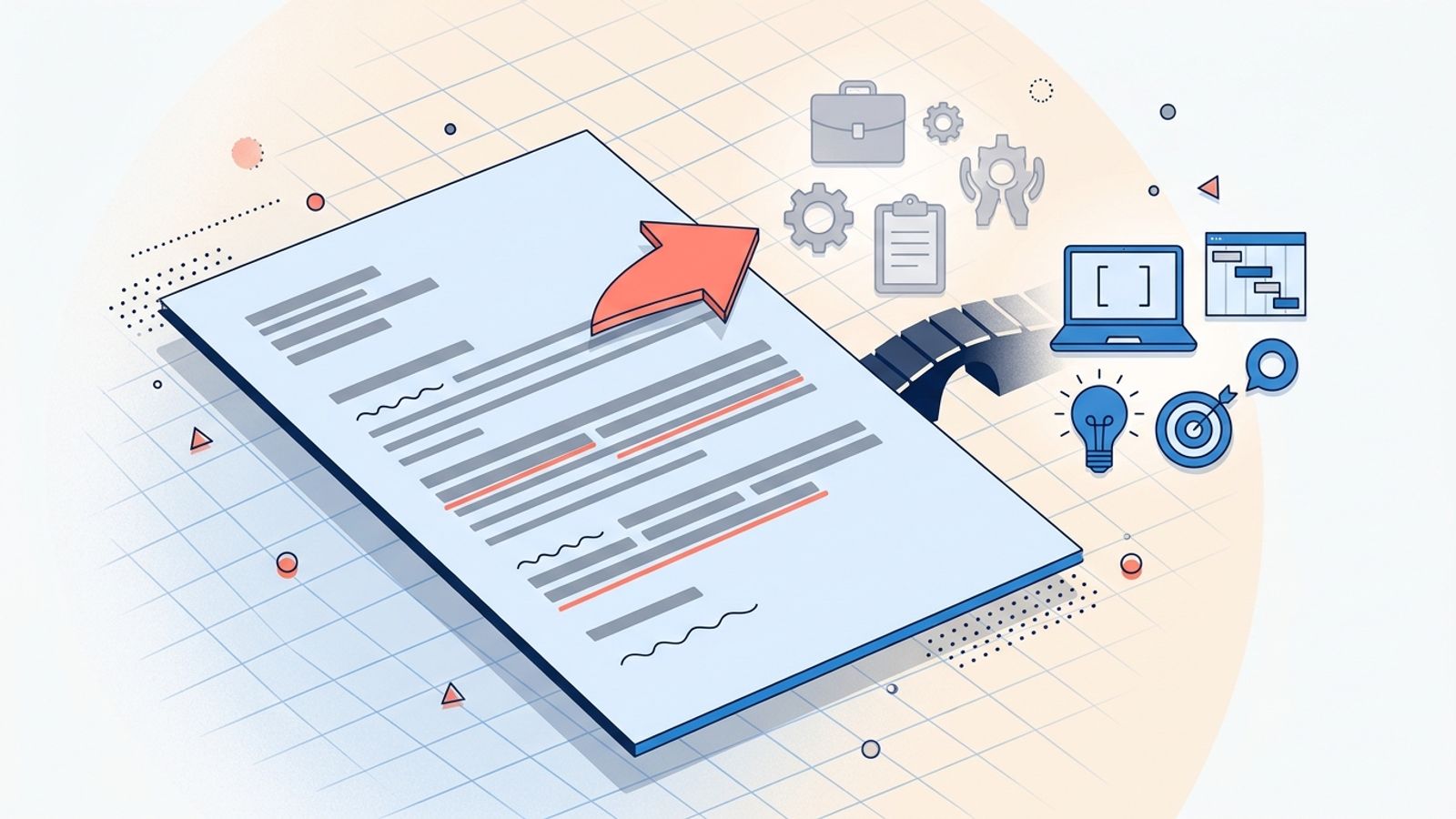
For a same-field application, the cover letter is optional. For a career change, it is the most important page in the whole stack. The resume can show what you have done; only the cover letter can answer the question every recruiter has when they see a pivot: "Why are you switching, and why should I take a chance on you in this field?"
Most career-change cover letters fail in the first sentence. "Although I lack direct experience in [target field], I am eager to learn..." reads as apology. Recruiters skim it, decide the candidate is uncertain about their own pivot, and move on. The fix is not enthusiasm. It is reframing the pivot as a deliberate decision with quantified value, not a hopeful guess.
This guide covers the template that actually works for pivoters, the five framings of the "why am I switching" sentence, two worked scenarios (teacher into instructional design, finance into tech PM), and the mistakes that kill the application before the second paragraph.
Mirrai Careers
Match your resume to any job in seconds
Upload your resume, paste a job description, see your match score.
Try FreeFree month of Pro with code LAUNCH
Why a Career Change Cover Letter Matters More Than Any Other
Three reasons the cover letter matters more for a pivot than for a same-field application:
- Your resume cannot answer "why now?" The job titles in your work history say "Logistics Coordinator" or "Registered Nurse" or "High School Teacher." Without a cover letter, the recruiter fills in their own answer to why you are applying for a tech-PM role, and the default fill-in is rarely flattering.
- The cover letter is where you control the framing. The pivot story belongs there, in your own words, before the recruiter has to invent one. One paragraph of clear context can move an application from "confused candidate" to "deliberate pivoter with transferable value."
- Hiring managers in 2025-2026 surveys report reading cover letters more carefully for non-traditional candidates than for traditional ones. The Interview Guys 2025 review found 83% of hiring managers said they were reading cover letters in 2025, with the heaviest read-through for pivoters and returners.
What a Career Change Cover Letter Has to Do
Three jobs, in order. If the letter does the first two but skips the third, you get an interview. If it skips the first one, the resume never gets opened.
- Answer "why are you switching?" in one or two sentences. Specific, forward-looking, no apology. The recruiter needs the answer in the first 50 words or they fill it in for you.
- Translate one or two concrete accomplishments from your old field into target-field value. Not "I have transferable skills"; rather, "I led a $12M cross-functional rollout in logistics that mapped directly to the program-management work in this role."
- Name a specific reason this company and this role, not a generic "I am excited by your innovative work." Reference a product, a team, a public initiative, a stated company priority. Specificity is the cheapest credibility move in cover-letter writing, and it is especially important for pivoters because it shows the pivot is targeted, not desperate.
The Career Change Cover Letter Template
300-400 words. Four paragraphs. Five elements:
Annotated template (replace bracketed items)
Dear [Hiring Manager name if findable, otherwise "[Company] Hiring Team"], I am applying for the [exact role title] position at [Company]. After [N years/months] of [old-field work], I am moving into [target field] full-time, building on [specific transferable strength]. Your [specific reference: a recent product launch, blog post, team initiative] is the kind of work I have been preparing for. In my current role at [old-field company], I [primary accomplishment with numbers]. The most directly relevant example: [one concrete project covering scope, scale, stakeholders, and outcome with metric]. This is the same kind of work the [target role] does, just in a different industry. To support the move into [target field], I have [concrete preparation: cert, bootcamp, project, freelance work, internal pivot at current role]. The combination of [old-field experience] and [target-field preparation] is what I would bring to this team on Day 1. What draws me to [Company] specifically is [specific reference: a team, a leader, an open initiative, a public company priority]. The chance to apply [your differentiator] to [their challenge] is why I am writing rather than applying through a portal. I am available [date] and would value a 30-minute call to walk through [specific aspect of the JD]. My resume is attached, with [specific most relevant accomplishment] on page one. Thanks for your time, [Your name] [Phone] | [Email] | [LinkedIn URL]
The annotated parts are what a recruiter spends 60 seconds on. The rest is scanned. Anything that does not match one of the three jobs above (why switching, transferable proof, why this company) can be cut.
"Why I Am Switching": 5 Frames That Work
The "why now?" sentence is the most-rewritten line in any career-change cover letter. Five framings that read as deliberate rather than uncertain:
Frame 1: The Adjacent Discovery
"After 8 years in logistics, the program-management dimension of the work became the part I cared about most. PMP certification confirmed what the day job had been teaching me: I want to do this work in tech, where the systems and the stakes are different but the discipline is the same."
Use when: your old job already contained elements of the target field, and the pivot is more accurately described as a re-emphasis than a leap.
Frame 2: The Industry Reset, Same Function
"After 6 years as a project manager in financial services, I am moving into tech. The methodology, the stakeholder management, and the program rigor are the same. The reason for the move is the velocity of decisions and the depth of customer feedback that tech offers, which is the environment I want to operate in for the next decade."
Use when: you are keeping your function and changing your industry. The cleanest pivot story; the resume already shows most of the relevant work.
Frame 3: The Skill Translation
"After 9 years teaching middle-school science, I have spent the last 12 months building learning content for adults: two corporate-training contracts and the Google Project Management cert. The work translates directly. The audience changes; the craft of designing structured learning does not."
Use when: the connection between old field and new field is not obvious to a recruiter scanning the resume, and the cover letter has to make the bridge explicit.
Frame 4: The Constraint Removal
"My first decade in clinical nursing taught me what I am good at: high-stakes coordination, fast triage, working under hard constraints. Moving into clinical informatics is the move from doing that work bedside to designing the systems that scale it across hospitals."
Use when: you are leaving a job where the work was meaningful but the role itself was unsustainable. Names the strength of the old role without trashing it; positions the new role as the same strength at higher scale.
Frame 5: The Long-Planned Move
"I started my career in marketing operations because it was the fastest way to learn how businesses run. For the last three years I have been building toward product management deliberately: shadowing PMs on three cross-functional launches, completing the Google PM certificate, and shipping two side projects. This is the move I have been preparing for."
Use when: the pivot is real and the preparation is documentable. Reads as the most credible frame because the work has already been done; the cover letter just names it.
Two Worked Examples
Example 1: High-school teacher to instructional designer
Career change cover letter, teacher into instructional design
Dear EdTech Hiring Team, I am applying for the Instructional Designer position at [Company]. After 9 years teaching high-school science and 12 months building corporate-training content on the side, I am moving into instructional design full-time. Your recent rollout of the [Product] adult-learning platform is the kind of work I have been preparing for. In my classroom role, I designed 4 multi-week learning units used by 600+ students per year, redesigned the school's STEM curriculum across grades 9-11, and trained 6 colleagues in the new framework. The retention and assessment-pass-rate gains were 18% and 22% respectively over two academic cycles. To support the move into instructional design, I completed the IDOL Academy program (Q4 2025), shipped 2 paid contract projects for B2B clients (a 6-week sales-onboarding course for a SaaS company and a compliance refresher for a healthcare provider), and built a portfolio of 3 standalone modules in Articulate Storyline. What draws me to [Company] specifically is your team's published commitment to scenario-based learning in adult onboarding, which is the design philosophy I have been working in for the last 18 months. The opportunity to bring 9 years of classroom design experience and 12 months of corporate ID work to this kind of role is what I am writing about. I am available starting [date] and would welcome a call to walk through the [specific module from the JD] I built for the SaaS client. Thanks for your time, Alex Lee (555) 234-9182 | [email protected] | linkedin.com/in/alexlee-id
Example 2: Finance analyst to tech product manager
Career change cover letter, finance into tech PM
Dear [Company] Product Hiring Team, I am applying for the Product Manager position at [Company]. After 6 years in financial-services analytics, I am moving into tech product management full-time. Your latest [Product] release is the kind of customer-facing analytics product I have been building toward. In my current role at [Bank], I led the rebuild of the firm's risk-reporting platform from concept through launch: I owned requirements with 12 stakeholders across 4 business units, ran the 9-month delivery cycle alongside a 5-engineer team, and managed the rollout to 800 internal users. The platform replaced 14 legacy spreadsheets and cut weekly close-cycle time from 36 hours to 7. The work was product management in everything but title. To make the move explicit, I completed the Reforge Product Strategy program (Q3 2025), shipped a customer-discovery side project for a B2B SaaS startup as a contract PM, and have been the primary PM voice on two cross-functional initiatives at my current company. What draws me to [Company] is the [specific product or team detail from public materials]. Bringing 6 years of finance-analytics depth to a product team building [their domain] is the bet I want to make next. I am available [date] and would value a call to talk through the discovery framework I used in the side project. Thanks for your time, Sam Kapoor (555) 487-2210 | [email protected] | linkedin.com/in/samkapoor
Both examples follow the same skeleton: one-line role and pivot statement, one paragraph of prior-field proof with numbers, one paragraph of target-field preparation, one paragraph of company-specific fit, one closing line with an action. None of them open with "Although I lack experience."
A 400-word letter with a real company reference doesn't scale to 50 applications, and it shouldn't. You write this for the handful of roles that actually fit the pivot, which means finding those roles first. A search that ranks live openings against your resume surfaces the pivot jobs where your translated experience already clears the bar, so the company-specific paragraph writes itself from a real match instead of a hopeful stretch. Mirrai's AI Job Search pulls them straight from company career pages, so your best cover letters land on the applications most likely to call back.
Common Career Change Cover Letter Mistakes
- Opening with an apology. "Although I lack direct experience in [field]..." plants doubt in the first ten words. If you do not sound confident about your pivot, the recruiter will not be confident either. Lead with what you bring, not what you lack.
- Spending the whole letter on why you are leaving your old field. The reader does not care about your old field. They care about whether you can deliver in this role. One sentence on the pivot reason; the rest on value.
- Listing every transferable skill without connecting any of them to specific work. "Strong communication, leadership, and problem-solving skills" is filler. "Led a 12-person cross-functional team through a $4M rollout" is the same skill, written as evidence.
- Repeating the resume. The cover letter is for context the resume cannot provide: the pivot story, the company-specific fit, the one or two accomplishments that map directly to the target role. If a paragraph in your letter is a bullet from your resume, the paragraph is wasted.
- Skipping company-specific reference. "I am excited by your innovative work in [field]" applies to 2,000 companies. Name the product, the team, the launch, the blog post, the public initiative. Specificity is doubly important for pivoters because it proves the move is targeted, not desperate.
- Stacking the AI-default patterns. Em-dashes 5+ times, "not just X but Y" sentence templates, generic claims with no numbers. Recruiters in 2026 can spot ChatGPT default output in 30 seconds. Use AI to draft if you want, but rewrite every sentence to add specifics.
- No clear call to action at the end. "I look forward to hearing from you" is filler. "I am available for a 30-minute call this Tuesday-Thursday, happy to walk through [the specific project from my resume]" is a next step the reader can act on.
Related reading: career change resume covers the resume side of the same problem. How to write a cover letter has the general framework if the pivot angle is not the main constraint.
Before you leave
See how your resume stacks up
Paste any job description and get your match score in 30 seconds.
Try FreeFree month of Pro with code LAUNCH
FAQ
Is a cover letter more important for a career change than for a same-field application?
How long should a career change cover letter be?
How do I explain the career change without sounding like I am running away from my old field?
Should I name the certification or bootcamp I completed?
Should I use AI to draft a career change cover letter?
How do I address a gap and a career change in the same letter?
How many career-change cover letters should I actually write?
The career-change cover letter is one page that decides whether the resume gets opened. Mirrai's Cover Letter Generator drafts a STAR-framework version from your resume and the JD, including the pivot-narrative paragraph, in under a minute. Use it as the first draft, then add the company-specific reference yourself. Free to try.