Mirrai Careers
How to Find a Job Fast: The 30-Day System That Works (2026)
Average job search in 2026 is 6.6 months and 62 applications (United Way NCA). Spray-and-pray makes it slower. A tight 30-day system with daily structure, targeted applications, and a working tracker is how people who land fast actually do it.

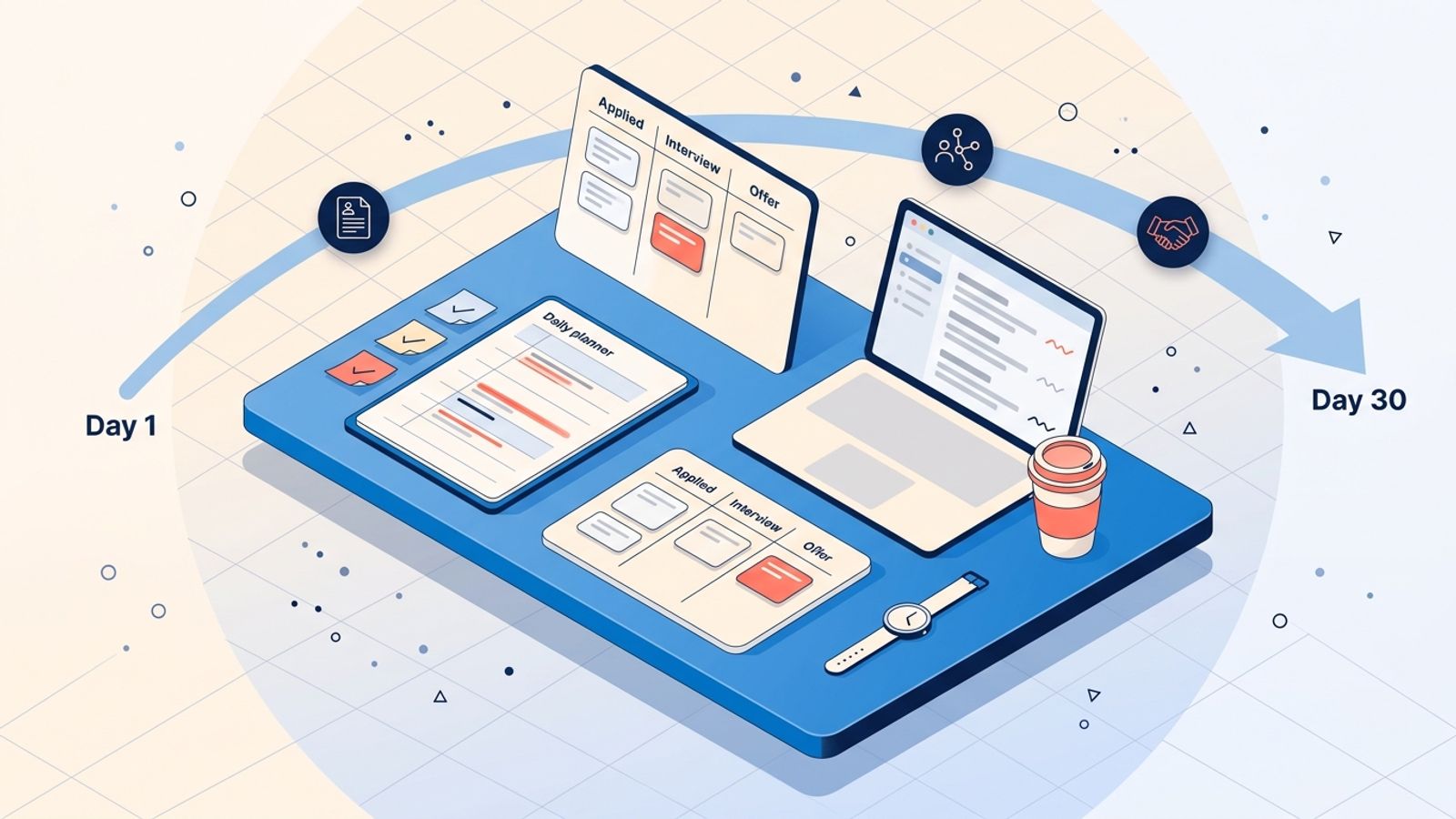
The honest "fast" number: the average U.S. job search in 2026 takes 6.6 months and 62 applications, eating 46+ hours just in application time (United Way NCA February-March 2026 survey). The median is shorter at 8.7 weeks (about 2 months), and 25.7% of unemployed workers in early 2026 have been jobless for 27 weeks or more, about 1.93 million people (BLS April 2026).
Two of those numbers are useful. The 6.6-month average is dragged up by long-term unemployment cases; the median 8.7-week timeline is closer to what an organized search looks like. "Fast" in 2026 means landing inside that median or beating it, typically 4-12 weeks from start to offer. The path to fast is structural, not motivational: tighter targeting, daily routine, working tracker, network used early. The opposite of fast is sending 200 generic applications and waiting.
This guide covers the 30-day system that actually compresses the timeline: the Week 1 setup, the daily routine, the sources that convert and the ones that do not, the full job-search checklist, and the mistakes that add months without anyone noticing.
Mirrai Careers
Match your resume to any job in seconds
Upload your resume, paste a job description, see your match score.
Try FreeFree month of Pro with code LAUNCH
The Honest Timeline: What "Fast" Actually Means
The "I will get a job in 2 weeks" framing usually ends in disappointment. The "this will take 6 months" framing usually becomes a self-fulfilling prophecy. The middle is where the data lives:
| Search type | Typical timeline | Applications needed | Common pattern |
|---|---|---|---|
| Targeted, tight system, network active | 4-8 weeks | 20-40 tailored | Inbound referrals + direct apps to fit roles |
| Targeted, no network | 8-12 weeks | 40-80 tailored | Direct apply to well-fit roles |
| Untargeted spray-and-pray | 4-9 months | 150-300+ generic | Mass apply, low response, burnout |
| Career-pivot or returner | 12-24 weeks | 60-120 tailored | Plus 1-2 cert/portfolio steps |
| Stuck in long-term unemployment | 27+ weeks | 200+ uncoordinated | Common pattern: no system, demoralized |
A 45% callback-rate lift was observed in LinkedIn data among job seekers who followed a daily plan vs those who did not. The structure is the lever; the structure makes the rest of the search work.
Week 1: The Setup That Compresses Everything
The first 5-7 days are not for applying. They are for building the system that makes the next 25 days compound. Skip this week and the search will be slower, not faster.
- Define the target. 1-3 job titles, max. Senior PM, Product Marketing Manager, Solutions Engineer. Not "anything in tech." A target this tight makes the resume, the JD-search, and the network outreach all aim at the same outcome.
- Tailor a base resume to the target. One resume per cluster of roles, not one per job. The role-specific tailoring happens at each application; the base should already be 80% there.
- Optimize LinkedIn. Headline that names the target role, About section that opens with the role plus scope plus one quantified outcome, Skills section that mirrors the JD vocabulary of 5-10 target postings. Recruiters search LinkedIn before they post; "Open to work" filter on if appropriate.
- Build the company list. 30-50 target companies, ranked by fit and likelihood of hiring for your target role in the next 90 days. This is the inbound pipeline; checking these companies' career pages weekly beats waiting for job boards.
- Set up the tracker. Spreadsheet or Kanban tool with 8 columns: Company, Role, Source, Date Applied, Resume Version, Status, Follow-Up, Notes. Full template in our companion piece on job-tracker spreadsheets.
- Map the network. 30-50 people who could refer or warm-intro you to a target company. Former coworkers, school contacts, industry-meetup contacts, LinkedIn 2nd-degree connections at target companies. Sort by how likely each is to actually help.
- Draft the outreach templates. Three short messages: cold reach to a stranger at a target company, warm reach to a former colleague, follow-up after no reply at 7 days. Drafted in advance, customized per send.
On the tracker side: job-tracker spreadsheet template has the full 8-column copy-paste template. Mirrai's Application Tracker is the Kanban version with automatic follow-up reminders if you prefer that to a sheet. Both work; the worst tracker is no tracker.
The Daily Job Search Routine (2-3 Hours That Compound)
Three focused hours per day beats eight scattered ones. The daily structure that produces the fastest results in observed job-search data follows the same shape across industries:
A working 3-hour daily routine
08:30 - 09:00 (30 min): Check inbox and tracker - Reply to recruiter messages, schedule interviews, log responses in tracker - Update Status column for any movement since yesterday - Check Follow-Up column: anything overdue? 09:00 - 10:30 (90 min): Targeted applications (2-4 per day) - Open 1 target-list company or top JD board hit - Read the JD carefully - Tailor the base resume (15-20 min per app) - Draft 1-paragraph cover letter or skip if not required - Submit; log in tracker; move on 10:30 - 11:30 (60 min): Network outreach (1-3 messages) - 1 cold message to a person at a target company - 1-2 warm follow-ups to people who replied or stalled - 1 LinkedIn comment or post that gets you visible to recruiters Total: ~3 hours, 2-4 applications, 2-3 network touches, tracker stays current
That cadence puts you at 10-20 tailored applications per week and 10-15 network touches per week. At a typical 5-8% response rate on well-fit tailored applications and 10-15% on referrals, this generates 2-5 interview conversations per week within the first 3-4 weeks for most reasonably-marketed candidates.
Sources That Convert vs Sources That Waste Time
Not every source produces interviews at the same rate. The fast-search data is consistent: high-context sources (referrals, direct outreach to target companies, targeted board hits) convert 5-10x better than mass aggregators.
| Source | Conversion to interview | Effort per app | Use for |
|---|---|---|---|
| Employee referral | 12-25% | Low (one warm message) | Top of every search |
| Direct apply at target-list company | 8-15% | Medium (tailored resume + cover) | Daily backbone of the search |
| Recruiter inbound (LinkedIn message) | 15-30% | Very low (reply to message) | Always reply, even if not interested |
| Specialized job boards (industry-specific) | 5-10% | Medium | When in a niche |
| LinkedIn Jobs (with tailored resume) | 3-7% | Medium | Daily search; tailor every app |
| Indeed / ZipRecruiter (mass aggregators) | 1-3% | Low if quick-apply | Use for volume only when other channels are filled |
| LinkedIn Easy Apply mass-submit | <1% | Very low | Skip; you are competing with 600+ generic resumes |
| Job-board email-blast newsletters | <1% | Low | Skip |
The rough rule: 60-70% of search time should go to the top three rows (referrals, direct apply at target companies, replying to inbound). The bottom three rows are filler that feels productive and almost never produces interviews.
One filter the table skips: freshness. A big share of board listings are stale reposts or outright ghost jobs, postings left up with no intent to hire, and every one of them can eat a tailored application for nothing. Going straight to a company's own career page sidesteps most of that, which is half the reason the top rows convert. The catch: nobody checks 50 career pages by hand every week. So a search that reads them for you earns its spot. Mirrai's AI Job Search pulls openings straight from career pages, refreshes through the day, and buries the ghost and long-open ones, so your weekly sweep takes minutes instead of an evening.
The Job Search Checklist (Full)
Run this once at the start, then weekly to keep the system healthy.
Setup checklist (Week 1)
- 1-3 target job titles defined
- 30-50 target companies listed and ranked
- Base resume tailored to target
- LinkedIn profile optimized (headline, About, Skills, Open to Work if appropriate)
- Tracker set up with all 8 columns
- Network mapped (30-50 contacts), sorted by likelihood to help
- 3 outreach templates drafted
- References notified (3-5 people pre-warned)
- Calendar blocked for daily 3-hour routine
Daily checklist
- 2-4 tailored applications submitted
- 1-3 network messages sent (cold + warm + follow-up)
- Inbox and tracker checked twice (morning + late afternoon)
- Follow-up overdue items addressed
- Tracker statuses updated for any responses
Weekly checklist
- Review tracker: which sources converted, which did not, where are stale follow-ups
- Refresh target-company list (add new companies, remove ones that closed reqs)
- Send 5-10 follow-up messages on apps over 7 days old without response
- Block 1-2 hours for interview prep (practice common questions, refresh the JD-specific story)
- Take a full day off the search (Saturday recommended) to prevent burnout
How to Organize the Search So It Stays Fast
A fast search is an organized search. Three artifacts do most of the work:
- The application tracker. 8 columns, one row per application, updated immediately after each submission. Without it, you double-apply, miss follow-ups, and lose track of which resume version went to whom. See our companion piece for the full template.
- The contact CRM. Separate tab or document for people you have spoken to: name, company, role, how you connected, last contact date, next contact date. This is what makes the search compound: every contact you make is a node in a network that pays off in this search or the next one.
- The pipeline view. Once a week, look at the tracker and answer: how many active applications, how many interviews scheduled, how many follow-ups overdue, how many referrals in flight. If the pipeline is thin, daily app volume goes up. If interviews are stalled at one stage, the prep for that stage gets a focused hour.
“I stopped treating the job search like hope and started treating it like delivery. I built a system. Applications became tickets. Networking became a daily KPI. Learning became non-negotiable. When motivation disappeared, the routine carried me.”
That post (15-year IT professional, post-layoff search) hit the top of r/jobs because everyone reading recognized the shift: the moment you stop treating the search as emotional and start treating it as operational is the moment the timeline starts compressing.
Common Mistakes That Slow Everything Down
- Spray-and-pray. Sending 200 generic applications per week feels productive and produces a ~1% response rate. The same 50 hours spent on 20 tailored applications produces a ~10% response rate. Same total volume in absolute callbacks; far less burnout.
- No tailored resume per application. ATS scoring drops sharply on generic resumes. 97% of Fortune 500 companies use ATS with AI filters in 2025. Tailoring the resume per JD is the single highest-impact 15-minute activity in the daily routine.
- Skipping the tracker. After 30 applications without a tracker, you cannot tell which sources convert, which roles you double-applied to, or which follow-ups are overdue. The search slows because you stop learning from your own data.
- Treating it like a part-time hobby with no daily routine. Job seekers without a daily plan take measurably longer to land (LinkedIn data: 45% slower callbacks). Even 2 hours per day in a consistent block beats 6 hours one day, 0 the next.
- Ignoring the network. 70% of jobs are filled through referrals or internal moves; only 30% are publicly posted. Spending 100% of your search time on public postings is competing for 30% of the market.
- Never following up. 7-day follow-up on no-response applications adds roughly 10-15% to total callback rate at zero extra application cost. Most candidates skip it.
- Burnout from no breaks. A full day off per week is the floor. The search is a multi-month event; treating it as a sprint produces collapse around week 4.
- Optimizing the wrong end. Endlessly tweaking the resume while making zero phone calls. The resume hits about 80% of its potential after the first careful pass; the next 20% is marginal. Move to outreach and interview prep instead.
Related reading: how to apply for a job for the per-application playbook. How to tailor your resume to a job description for the tailoring mechanics. Thank you email after interview for the 24-hour follow-up that closes deals other candidates leave open.
Before you leave
See how your resume stacks up
Paste any job description and get your match score in 30 seconds.
Try FreeFree month of Pro with code LAUNCH
FAQ
How fast can I realistically find a job in 2026?
How many applications should I send per day to find a job fast?
What is the best job board to use in 2026?
How important is networking for a fast job search?
Should I treat job searching as a full-time job?
What if I have been searching for 6+ months with no results?
Where can I find the freshest job listings?
The fast job search runs on three artifacts: a tailored resume per application, a working tracker, and a daily routine that survives bad moods. Mirrai's Resume Builder generates a tailored version against any JD in a minute, Job Matcher scores the result before you apply, and Application Tracker keeps the pipeline visible. Free to try.