Mirrai Careers
Certifications on a Resume: Where, How, and Which Ones Pay (2026)
PMP holders earn 33% more. AWS certs add 26% to salary. Where to place certifications on your resume by experience level, the exact line format, and which credentials actually move the needle.

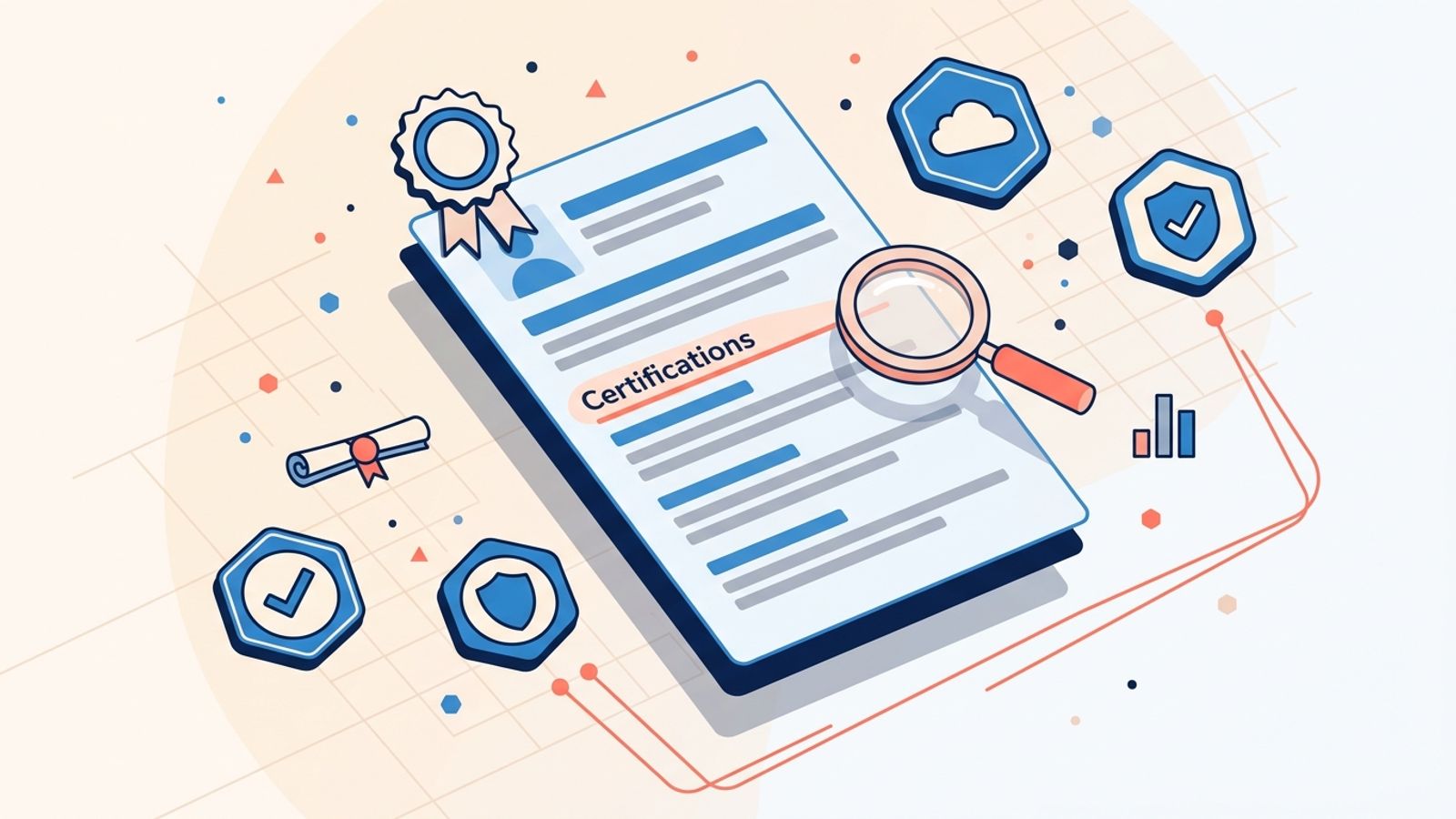
PMP-certified project managers earn 33% higher median salaries than uncertified peers (PMI 2025 Earning Power Salary Survey). AWS-certified professionals add about 26% to their base, with the lift higher at entry level and tapering with experience (AWS 2025 industry salary report). SHRM-certified HR professionals report 14-15% premiums. The certification itself is one signal; how you list it on your resume is what determines whether the ATS finds it and the recruiter notices it.
52% of target-job keywords are missing from the average unoptimized resume (ResumeAdapter 2026 pipeline analysis). Certifications are some of the highest-weight keywords because they map directly to job posting requirements: "must have CPA," "AWS Solutions Architect required," "PMP preferred." If your credential is real but listed in a way the parser cannot read, you do not appear.
Below: are certifications worth listing at all, where to place them by career stage, the exact format that ATS reads, top certifications by industry with current salary data, what to do with in-progress and expired credentials, and the trap of relying on the cert alone.
Mirrai Careers
Match your resume to any job in seconds
Upload your resume, paste a job description, see your match score.
Try FreeFree month of Pro with code LAUNCH
Are Certifications Worth Listing? Honest Answer
Three buckets:
- Legally required or industry-standard (CPA, RN, PMP for many PM roles, CISSP for senior security, NCLEX for nurses, Bar admission for lawyers): always list. Often at the top, next to your name.
- Relevant and recent (within 5 years) for the target role: always list. These are direct ATS keyword matches.
- Old, outdated, or unrelated (your 2009 Six Sigma Yellow Belt for an SWE role): leave off. It dilutes the relevance signal and ATS scores you against irrelevant keywords.
The decision rule: would a recruiter searching the database for this role type pull your resume because of this cert? If yes, list it. If no, the slot is better used for a relevant skill or achievement.
Where to Place Certifications by Career Stage
Placement is not a style preference; it is a signal of what the rest of your resume can carry. Three patterns work, by experience level:
| Career stage | Placement | Why |
|---|---|---|
| Early-career (0-3 years) | Top of the page, directly under your summary | Your work history is thin; certifications carry more of the credibility load |
| Mid-level (4-8 years) | After work experience, before education | Work history is the lead signal; certifications back it up |
| Senior (8+ years) | Bottom, after education | Track record speaks; certifications are supplementary |
| Required licenses (CPA, RN, PMP) | Next to name at the very top, in credentials line | Some postings filter on these before reading anything else |
Required-license example for the top-of-page credentials line: "Sarah Chen, CPA, MBA" or "Marcus Reyes, RN, BSN." If a posting says "CPA required," that line gets the resume past the first filter before the parser even reads further.
A dedicated Certifications section is almost always better than burying credentials in the Education section. Recruiters and ATS both look for a section header titled "Certifications" or "Professional Certifications"; merging into Education hides them from both.
How to Format Certifications: The Exact Line
One line per certification. Four required fields, one optional:
- Full credential name + acronym in parentheses (so ATS catches both formats)
- Issuing organization (the official body, not a training provider)
- Date earned (month + year, or just year)
- Expiration date if applicable, or "Active through [year]"
- Optional: certification ID number, only if the role requires verification (CPA license number, NCLEX RN number)
Three correctly-formatted examples:
Correct format
Project Management Professional (PMP), Project Management Institute. June 2024. Active through June 2027. AWS Certified Solutions Architect, Associate (SAA-C03), Amazon Web Services. February 2025. Active through February 2028. Certified Public Accountant (CPA), State of California Board of Accountancy. License #156789. Active.
Three formats that fail ATS or recruiter scrutiny:
Incorrect format
PMP, 2024 (no issuing org, no full name, no expiration; ATS may not match "Project Management Professional" search) AWS Certified Solutions Architect (no level specified, no date, no expiration; recruiter cannot tell if it is Associate or Professional, or if it is current) Google Analytics Cert, Hubspot Inbound, Coursera ML Specialization, edX Data Science... (10 micro-credentials buried in one line; looks like padding, dilutes the keyword signal)
The full-name + acronym pattern matters because ATS keyword search can target either format. Some recruiters type "PMP" into the database search; others type "Project Management Professional." Including both makes you a match for both searches.
Top Certifications by Industry (2026 Salary Data)
Certifications that consistently move the salary needle, by job family. Salary figures are US-based averages from industry salary reports (2025-2026).
| Industry | Top certifications | Salary impact |
|---|---|---|
| Cloud / DevOps | AWS Solutions Architect (Associate/Pro), Google Cloud Professional Architect, Azure Administrator | $95K-200K depending on level; 26% avg lift |
| Cybersecurity | CISSP, CEH, Security+, OSCP, CISM | CISSP avg $130K-165K; widely required on senior postings |
| Project Management | PMP, PRINCE2, Certified ScrumMaster (CSM), SAFe Agilist | PMP holders earn 33% more median than non-PMP |
| Data / Analytics | AWS ML Specialty, Google Data Engineer, Databricks Certified, Tableau Desktop Specialist | AWS ML Specialty avg $160K (highest in AWS family) |
| Finance / Accounting | CPA, CFA, CMA, ChFC, Series 7 / Series 63 / Series 65 | CPA required for public accounting; CFA adds 15-25% in investment roles |
| Healthcare | RN, BSN, ACLS, PALS, BLS, specialty certs (CCRN, OCN, CEN) | License required to practice; specialty certs add $5K-15K |
| HR / People Ops | SHRM-CP, SHRM-SCP, PHR, SPHR | 14-15% salary premium for SHRM-certified |
| Marketing | Google Ads, Google Analytics 4, HubSpot Inbound, Meta Blueprint | Lower direct salary lift; relevance for the keyword match on JD |
Two notes that matter for ROI calculations:
- The salary lift is correlated, not causal. PMP holders earn more partly because the kind of person who pursues a PMP tends to be in roles that pay more anyway. Studies that controlled for this find the lift is real but smaller (10-15% in PMI's own internal causal studies).
- The lift tapers with experience. Early-career cloud engineers report 30% lifts after their first AWS cert; senior architects with 10 years of cloud experience see closer to 5-10%. The cert closes a credibility gap; it does not multiply ceiling.
In-Progress and Expired Certifications
In-progress: list it if you have a realistic completion date within the next 6 months. The format:
In-progress format
AWS Certified Solutions Architect, Associate (SAA-C03). In progress. Expected completion: August 2026. (Currently 70% through study guide, scheduled exam date set.)
Two rules to avoid the "padding" read: include the exact expected date (not just "in progress") and indicate where you are in the process. A vague "in progress" with no date looks like aspirational filler.
Expired certifications: do not list them as if they are current. Three options:
- Drop entirely if the certification is no longer relevant to your target role.
- Renew, then list with the new active date.
- List with explicit "Expired [year]" notation only if it shows historical depth (e.g., "AWS Solutions Architect Associate, Active 2018-2023" on a senior architect resume signals the experience timeline; ATS still parses the cert, recruiter sees the gap).
Most ATS systems score expired certs as zero. Listing one as if active and getting caught at the verification stage is a fast path to immediate rejection.
When a Certification Alone Will Not Carry You
A certification opens a door that was closed. It does not walk you through the door. The most common failure mode is treating the cert as the solution when the underlying problem is positioning.
“Got my PMP certification 4 months back and been trying hard to break into project management in tech. No matter the combo of work experience and certification I list down, I always come off as having worked in logistics for the past few years and then added a certification to it. It feels like I'm applying for a job that I don't have any experience in.”
The PMP got the recruiter to read the resume. The resume then read as 10 years of logistics with a recent project management course bolted on. The fix is not another certification; it is rewriting the work experience bullets in project management language: cross-functional team size, budget responsibility, schedule recovery, vendor management, stakeholder communication. The same logistics work, framed as the project management it actually was.
The general rule: pair every certification on your resume with at least one work-experience bullet that demonstrates the skill in practice. AWS cert + bullet about a real cloud migration. PMP + bullet about a real cross-functional project with metrics. CPA + bullet about audit or close cycle work. The cert says you can; the bullet says you have.
To rewrite your bullets to match a specific role's expectations, see action words for your resume and skills to put on a resume.
Common Certification Mistakes That Sink the Section
- Listing every certification you have ever earned. 3-7 relevant is the sweet spot. More than 10 looks like padding and dilutes the keyword density of the section.
- Using only the acronym without the full name. "PMP" alone may not match an ATS search for "Project Management Professional." Always include both.
- Burying certifications inside the Education section. Recruiters scan for a "Certifications" header; merging into Education hides them.
- Listing micro-credentials and short courses as certifications. A 4-hour HubSpot intro module is not a credential. If it is not industry-recognized, put it under "Professional Development" or leave it off.
- Putting an expired cert with no date. Reads as either out-of-touch or dishonest depending on the reviewer.
- Listing certifications irrelevant to the role. Your 2018 bartending certification on a financial analyst resume is filler that dilutes the relevant keywords.
- Inconsistent formatting across the section. Some certs with dates, some without. Some with full name, some abbreviated. The inconsistency reads as careless.
Tailoring Certifications to the Job Description
The same way you tailor skills, tailor your certifications section to the posting:
- Open the job description and find the "Required" and "Preferred" certifications. These are the priority keywords.
- For each certification you actually have, match the wording in the JD exactly. If the JD says "Project Management Professional (PMP)," use that exact format on your resume. If it says just "PMP certification," include both formats anyway.
- Move the most JD-relevant certifications to the top of the section. ATS and recruiters both weight the first 1-2 items in a section more than the rest.
- If you have a relevant certification the JD did not explicitly mention but the role would clearly value, keep it. If it has no apparent connection, cut it.
- Run the resume through the Notepad test: select all, copy, paste into plain text. If the Certifications section comes out clean and ordered, ATS will read it the same way.
To check which certifications and keywords a specific job description expects, paste any JD into our Job Matcher and see your match score in 30 seconds.
Before you leave
See how your resume stacks up
Paste any job description and get your match score in 30 seconds.
Try FreeFree month of Pro with code LAUNCH
FAQ
How many certifications should I list on my resume?
Should certifications go above or below work experience?
Do I need to list the certification ID number?
Can I list a certification I am still studying for?
What if my certification expired?
Build a resume that surfaces your certifications in the right slots, with the formatting ATS actually reads. Mirrai's Resume Builder handles placement, format, and keyword matching automatically, so the cert you paid for actually gets seen.