Mirrai Careers
Career Development Plan: 5 Elements + 90-Day Framework (2026)
Most career plans fail because they are aspirations, not 90-day sprints. The 5 elements that work, the framework, and how to build a plan you actually ship on.


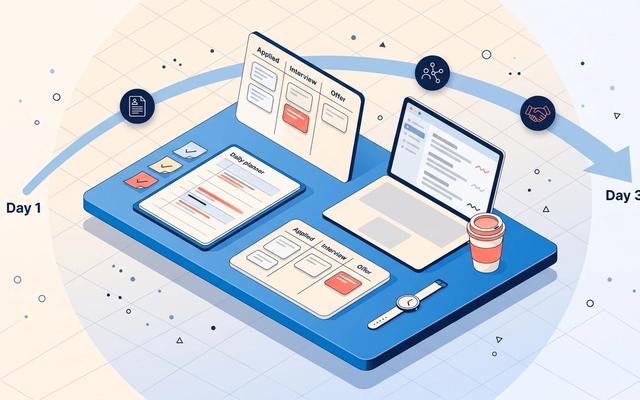
A career development plan written once a year, filed in a manager's OneDrive, and never opened again is a calendar reminder, not a plan. The version that actually changes your next 12 months has five specific elements, runs in 90-day sprints, and lives somewhere you actually open weekly.
The data: candidates with a written 90-day skill development plan are more than 2x as likely to hit a salary bump within 12 months compared to those without one (Amatum 2026 skill-development study). The version that fails is the one that lists goals like "improve communication" with no measurable behavior or deadline. The version that works names the specific weekly action, the metric, and the date.
Below: why most career plans fail, the 5 elements of one that does not, how to build it across 90 days, 1 year, and 3 years, examples by career stage, and how to actually track it. Plus when to skip the DIY route and let an AI map it out personalized to your situation.
Mirrai Careers
Match your resume to any job in seconds
Upload your resume, paste a job description, see your match score.
Try FreeFree month of Pro with code LAUNCH
Why Most Career Plans Fail
Three failure modes, all common:
- The plan is built around what your employer wants, not what you want. Annual reviews push you toward a "development plan" aligned to the company's next quarter. Your career is longer than the company's next quarter.
- The goals are aspirational, not behavioral. "Get promoted to senior" is an outcome, not an action. "Lead 2 cross-team projects with documented outcomes this quarter" is a behavior you can do.
- There is no review cadence. A plan you write in January and reread in December is a journal entry. A plan you check weekly is a system.
“I love my work, but someone said to me once, be loyal to the work that you do, not your job.”
That principle is the whole game. The plan is yours. Your company has plans for you that may or may not match yours. The career development plan is what keeps the two from drifting too far apart without you noticing.
The 5 Elements of a Real Career Development Plan
A plan that works has these five parts. Each maps to a question you should be able to answer in one sentence:
| Element | Question it answers | What it produces |
|---|---|---|
| 1. Map of tensions | Where am I stuck, and what is the conflict? | A clear-eyed read of the current career bottleneck |
| 2. Skill gap analysis | What do I need that I do not have? | A specific list of 2-3 skills to develop next |
| 3. Learning plan | How will I close the gap, by when? | Weekly actions, deadlines, and resources |
| 4. 90-day strategic plan | What ships in the next quarter? | Concrete weekly behaviors with measurable outcomes |
| 5. 3-year directional vision | Where is this all going? | The role, level, and life shape you are aiming for |
Building all five takes 2-3 hours of focused thinking. The output is a one-page document. Anything longer than a page is not a plan; it is a wish list.
If you want this same 5-part plan generated for you, personalized to your situation, with the AI doing the research and pattern-matching, Mirrai's Career Test produces all five sections (map of tensions, skill gaps, learning plan, 90-day plan, 3-year vision) from a 10-minute input. The framework below is the manual version; the tool is the automated one.
Element 1: Map Your Career Tensions
Before goals, the diagnosis. The biggest reason career plans fail is that people skip this step and start with the goal. The goal is a function of what is broken; if you do not know what is broken, you pick the wrong goal.
A career tension is a conflict between two things you want that pull in opposite directions. Common ones:
- Money vs meaning: the higher-paying job has none of the work you actually like.
- Specialist vs generalist: depth gets you promoted; breadth keeps you employable when the field shifts.
- Stability vs growth: the comfortable job at a stable company is also the one that is not teaching you anything new.
- Manager vs maker: the only promotion path is into management; you do not want to manage people.
- Location vs role: the role you want is in a city you do not.
Write down 2-3 tensions you are sitting in right now. Be specific. "Work-life balance" is not a tension; it is a hashtag. "I am working 55 hours a week at a job that pays me 30% less than market" is a tension you can actually plan around.
Element 2: Run a Skill Gap Analysis
Pick the role you want next (not your 5-year dream role, the realistic next one). Pull 5-8 job postings for that role. Make a list of every skill, tool, certification, and experience mentioned across them. Mark each one:
- Have it solidly, can talk about it in an interview
- Have surface-level exposure, would not pass deep questioning
- Do not have it at all
The "would not pass deep questioning" and "do not have it" categories are your gap list. Pick the 2-3 most JD-frequent items from that list. Those are your development priorities for the next 12 months.
A separate guide walks through skill gap analysis in detail: skill gap analysis. For the resume side of which skills to surface, skills to put on a resume covers placement and format.
Element 3: Build the Learning Plan
For each of the 2-3 skill gaps, name three things: how you will learn it, by when, and how you will prove you learned it. A learning plan that just says "take a course" does not work because there is no proof step.
Learning plan example (one skill)
Skill: SQL for analytics How: Mode Analytics SQL tutorial (4 weeks of weekend study) + 2 personal projects using public datasets By when: Complete tutorial by end of month 1; first project by end of month 2; second project by end of month 3 Proof: Two completed projects published on GitHub with documented findings; one shared internally as a Slack post; ready to answer technical SQL questions in an interview
The proof step matters most. Knowing SQL means having shipped something with SQL, not having completed a course about it. If your learning plan has no proof step, it is a wish.
Element 4: The 90-Day Strategic Plan
Pick no more than 3 priorities for the next 90 days. One is better than three. Three is the absolute maximum. Anything beyond three guarantees you will hit none of them.
For each priority, define:
- The specific behavior (what you will do, in a sentence)
- The weekly time commitment (be honest about your real free hours)
- The success metric (how you will know it worked, in numbers)
- The midway check date (day 45)
- The end date (day 90) and what gets shipped
90-day plan example: Strategic Climber going for Senior Analyst
Priority 1: Build advanced SQL portfolio. - Behavior: Spend 6 hours per week (Saturday morning + 2 weeknights) on SQL projects. - Metric: 2 shipped GitHub projects with documented findings by day 90. - Day 45 check: First project shipped; tutorial complete. - Day 90: Both projects live; ready to discuss in interviews. Priority 2: Lead a visible cross-team initiative at current job. - Behavior: Propose and co-lead the marketing-product attribution audit (1-2 hours per week + 1 weekly meeting). - Metric: Audit ships with 3 actionable recommendations adopted by both teams. - Day 45 check: Scope agreed; data collection in progress. - Day 90: Audit shipped; recommendations adopted; documented as a portfolio piece. Priority 3: Update resume + start applying. - Behavior: Rewrite resume in week 4; apply to 5 senior roles per week starting week 5. - Metric: At least 4 first-round interviews by day 90. - Day 45 check: 20 applications sent, response rate measured. - Day 90: Application velocity and conversion rate review.
Three priorities. Each one has a behavior, a metric, and a date. Anything vaguer than this is not a plan, it is a hope.
One 90-day priority that turns vague fast is "apply externally." Both example plans below include it, and most real plans do, because the fastest lever on comp and title is usually a move, not a wait. "Send applications" isn't a behavior with a metric until you know which roles to send them to. A search that ranks live openings against your resume gives the 90-day plan a real target list: the specific roles that fit, ranked, with the match shown. Mirrai's AI Job Search reads them straight from company career pages, so "apply externally, week 8" becomes ten named openings instead of a line you keep sliding to week 12.
Element 5: The 1-Year and 3-Year Horizon
After the 90-day sprint, two longer horizons keep the direction consistent:
| Horizon | What it answers | How precise it should be |
|---|---|---|
| 1 year (next 4 sprints) | What role am I targeting? What 4 skill gaps will I close? | Specific role title, target company tier, 4 skill development cycles |
| 3 years (directional) | What does the next chapter of my career look like? | Function and seniority level, not a specific company or title |
The 1-year plan should be specific. The 3-year vision should be directional only. The reason: 1-year is short enough that you can predict most of it; 3 years is long enough that your industry, your life, or your interests will shift the destination. Pretending you can plan 3 years in detail is the most common failure mode of corporate-template career plans.
If your 3-year direction is a pivot rather than a climb, career change guide covers the pivot-specific framework.
How to Track and Adjust Your Plan
A weekly 15-minute review is the only routine that matters. Skip it for two weeks and the plan dies.
What to check each week:
- Hours actually spent on each priority vs hours planned. If you missed by more than 30%, the plan is too ambitious or your week is too overloaded; one of those has to change.
- Whether the weekly behavior happened. Did the SQL project move forward? Did you send the 5 applications? Yes/no.
- New tensions that emerged. Did your manager change a project that affects priority 2? Did a competing job offer change your salary anchor?
- Adjustment needed for next week. Same priorities, different schedule? Drop one priority and reallocate?
At the 45-day midway point, the bigger check: are the metrics tracking toward the 90-day target, or are they behind? If behind, you adjust the metric or the scope, not the deadline. Sliding the deadline turns a 90-day plan into a permanent "soon."
Career Development Plan Examples by Stage
Example 1: Early-Career (2-3 years experience, marketing coordinator targeting marketing manager)
- Tension: I have the title of coordinator but doing manager-level work without the comp; my company is unlikely to promote internally in the next 12 months.
- Skill gaps: paid ad strategy (not just execution), team leadership experience, P&L responsibility exposure.
- Learning plan: complete Meta Blueprint certification + Google Ads certification (~80 hours over 4 months); shadow the current marketing manager on 2 campaigns; volunteer to mentor a junior coordinator.
- 90-day plan: ship the cert; propose and lead one campaign end-to-end with documented results; start applying externally for marketing manager roles week 8.
- 1-year target: marketing manager role at a Series B-C SaaS company.
- 3-year direction: senior marketing manager or director of growth marketing at a mid-stage tech company.
Example 2: Mid-Career (8 years experience, software engineer targeting tech lead)
- Tension: I am the strongest IC on my team but my company has no tech lead opening; the path to staff is blocked by an existing staff engineer who is not moving.
- Skill gaps: architecture design for systems I have not built (specifically: event-driven systems at scale), mentoring junior engineers, technical decision documentation (RFCs).
- Learning plan: read Designing Data-Intensive Applications (3 months); contribute to one large-scale open-source project; write 4 internal RFCs at work covering decisions I would normally make verbally.
- 90-day plan: ship 2 RFCs and get them adopted; start weekly 1:1 mentoring with a junior engineer; complete first half of DDIA with notes.
- 1-year target: tech lead role at a Series C or later company (external move), or staff promotion (internal, if path opens).
- 3-year direction: principal engineer or engineering director, depending on whether I lean toward IC depth or people management.
DIY Career Plan vs Personalized AI Career Plan
The framework above is enough if you have 2-3 hours, the right kind of self-honesty, and a clear read of what is breaking in your current trajectory. Most people have one or two of those, not all three.
Where the DIY route runs into trouble:
- Diagnosis blindness. You know something is off; you cannot name it. Naming the tension correctly is the hardest part and the part most people skip.
- Skill gap calibration. You think you need to learn X; the market actually rewards Y. Reading 50 job postings to figure out which is true takes hours and most people give up at 5.
- Plan ambition mismatch. Either you set goals so big you will never hit them, or so safe they will not change anything. The right level is hard to calibrate alone.
That is why Mirrai's Career Test exists. A 10-minute Tally form input generates a personalized Career Plan with the same five sections covered here: a map of your specific career tensions, your hidden superpowers and skill gaps, a learning plan, a 90-day strategic plan with phases and metrics, and a 3-year directional vision. The AI does the diagnosis pass, the market research, and the calibration; you get a plan that took 10 minutes of input instead of 2-3 hours of solo thinking.
The teaser is free; the full plan with the strategic 90-day breakdown unlocks at $40. If you have the framework above and discipline to run it weekly, the DIY route works. If you want the diagnosis and calibration done for you with personalized data, the tool route is faster.
Try the Career Test to see what your personalized 5-section Career Plan looks like.
Before you leave
See how your resume stacks up
Paste any job description and get your match score in 30 seconds.
Try FreeFree month of Pro with code LAUNCH
FAQ
How long should a career development plan be?
How often should I review and update my career development plan?
Should my career development plan match what my manager wants for me?
What if my career plan changes mid-sprint?
Do I need a career coach to build a development plan?
How do I make "apply externally" a real part of my 90-day plan?
Stop guessing at the plan. Mirrai's Career Test generates your personalized 5-section Career Plan from a 10-minute input. The framework above is the manual version; the tool is the automated one.